Activation: Where Web3 Adoption Begins
Adoption starts here. Most projects fail here.

Most Web3 projects do not have a user problem.
They have an activation problem.
That is the part most marketing teams keep stepping over, like it is a loose cable on the floor. They see sign-ups, wallet connects, airdrop claims, and then declare victory.
But acquisition is not adoption. It is only the opening scene.
In growth frameworks like AARRR (acquisition, activation, retention, referral, and revenue), activation sits between acquisition and retention for a reason. It is the moment a user moves from curiosity to actual product value, the point where they stop looking and start doing. The point of AARRR itself is to track where users actually move through the product, not just where they enter it.
Over here, Web3 projects have spent years optimizing the front door.
The industry has leaned hard on incentives, and incentives work. Airdrops have been one of the loudest growth levers in the space, with DappRadar estimating that projects have distributed more than $20 billion through airdrops since 2017, including $4.5 billion in 2023 alone. They also note that 88% of airdropped tokens lose value within three months.
That is the trap.
A lot of Web3 onboarding has trained users to behave like reward hunters. Not builders. Not loyalists. Hunters.

And to be fair, the ecosystem taught them that behavior. If every cycle rewards the fastest mover, the loudest opportunist, and the most opportunistic wallet, then the market should not act surprised when people show up for the prize and leave after the prizes are awarded.
This is why acquisition-heavy growth can feel impressive and still be structurally weak.
A16z Crypto has pointed out that crypto growth metrics need a blockchain-specific rethink, and that passive holders can convert into active users only if the product experience actually gives them a reason to act. They also highlight monthly mobile wallet users as an important signal for the next wave of crypto adoption, because more wallets do not matter unless people are actually using them.
Which brings up the real question.
Not, “How many people came?”
But, “How many people crossed the line into real usage?” - activation.
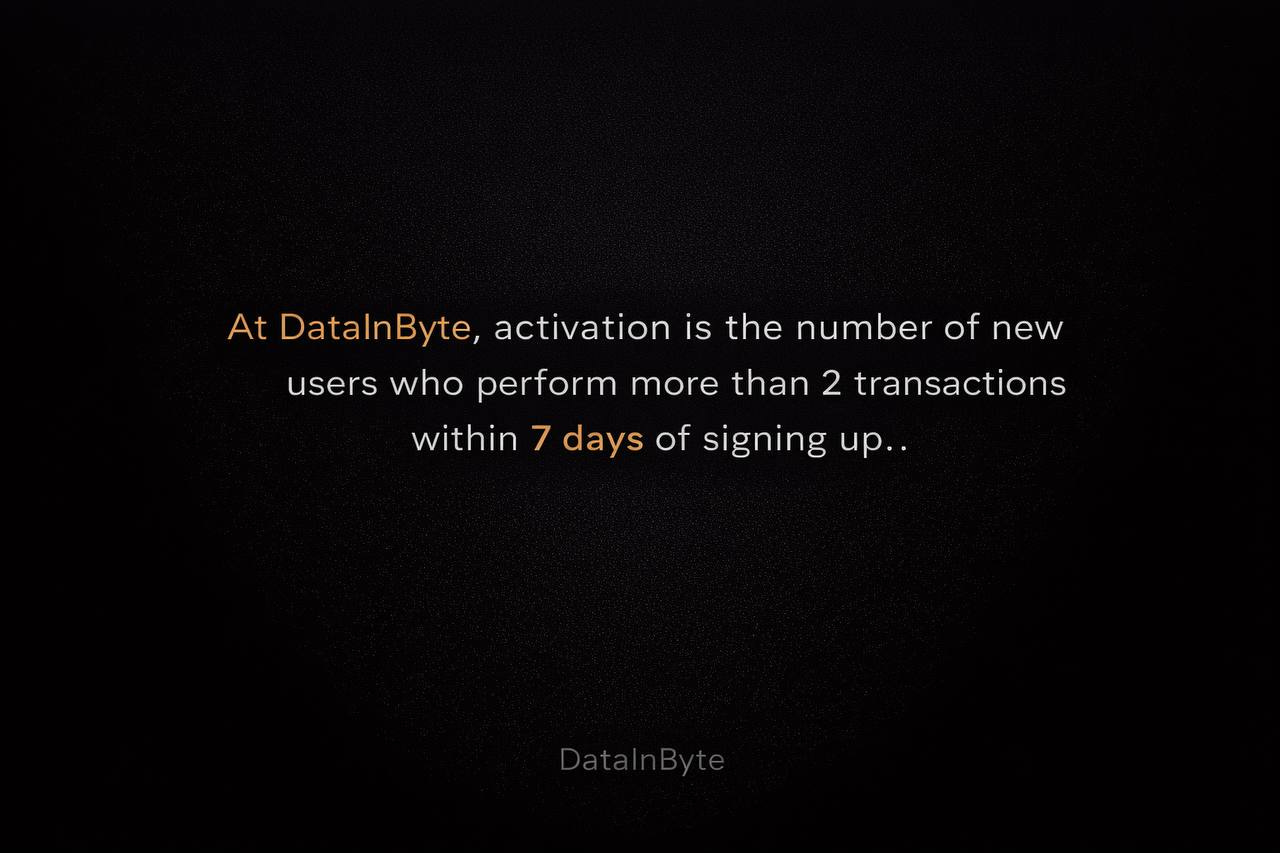
At DataInByte, activation is the number of new users who perform more than 2 transactions within 7 days of signing up.
That definition is intentionally simple. Simple is good. Simple is usable. Simple is measurable.
Why 2 transactions?
Because one transaction can be curiosity.
Two starts to look like intent.
Why 7 days?
Because the value that takes too long to appear often disappears before it matters.
Activation is where the product stops being a promise. It is the first honest proof that the user understood the product enough to come back on purpose.
This matters because retention cannot rescue a weak activation layer forever.
If the first meaningful experience is missing, the user does not have a reason to stay. They may claim, click, mint, swap, bridge, or farm. But if they never reach the moment of actual utility (second transaction where the user understands and intends the value behind the action), they are not really users. They are traffic with a wallet.
That is also why so many Web3 sectors keep running in circles. DappRadar’s Q3 2024 report showed daily unique active wallets reaching 17.2 million, up 70% quarter-over-quarter, but other key metrics like DeFi TVL and NFT trading volume told a more complicated story. More activity does not automatically mean deeper adoption.
Sometimes it just means the market got noisier.
DappRadar’s Q2 2025 blockchain gaming report described dozens of Web3 games shutting down, with weak retention and unsustainable tokenomics among the reasons. That is not just a gaming problem. It is a growth problem wearing a game controller.
This is why activation deserves to be treated as its own concept, not just a step in a funnel.
Activation is the bridge between distribution and durability.
It tells you whether your acquisition engine is attracting people who can actually become users.
It tells you whether your onboarding is helping people reach value fast enough.
It tells you whether your product has a real first win, or just a stylish landing page and a very expensive illusion.
A good activation metric should do three things.
First, it should be behavioral, not emotional.
Second, it should map to value, not vanity.
Third, it should predict retention, not merely celebrate entry.
That is where most projects get lazy.
Activation is not a marketing flourish. It is the first checkpoint of product truth.
And once you start looking at Web3 through that lens, a lot of things become less magical and more measurable.
The airdrop that looked like growth may have been just a temporary rush.
The campaign that brought traffic may have missed the actual use case.
The product that looked busy may have been quietly failing at the moment that mattered most.
So yes, Web3 has a user problem. But it is not the one most people think.
It is not a problem of people refusing to show up.
It is a problem of people not being converted into active users quickly enough.
That is the activation gap.
And that is where adoption either begins or quietly dies in the hallway.
In the next piece, we measure activation across real Web3 products using on-chain data.
This is where DataInByte begins.
Sources & Further Reading:
1. McClure, D. (2007). Startup Metrics for Pirates (AARRR) https://amplitude.com/blog/pirate-metrics-framework
2. DappRadar. (2024). 88% of Airdropped Tokens Lose Value Within 3 Months https://dappradar.com/blog/88-of-airdropped-tokens-lose-value-within-3-months
3. Andreessen Horowitz (a16z Crypto). (2024). Measuring Growth in Crypto https://a16zcrypto.com/posts/article/measuring-growth-in-crypto/
4. DappRadar. (2024). State of the Dapp Industry Q3 2024 https://dappradar.com/blog/state-of-the-dapp-industry-q3-2024
5. DappRadar. (2025). State of Blockchain Gaming Q2 2025 https://dappradar.com/blog/state-of-blockchain-gaming-in-q2-2025